Silk Clinics Dubai logo
Clinical assessment of skin type and Fitzpatrick skin tone before aesthetic treatment at Silk Clinics Dubai

Silk Clinics Dubai · Clinical guide

The Ultimate Skin Type & Skin Tone Treatment Guide in Dubai

Choosing the right treatment starts with two questions most clinics skip: what type is your skin, and how does it respond to light? This guide answers both — then maps every major treatment to Fitzpatrick types I–VI, downtime and safety.

Medically reviewed by Dr Suzanne Haddad, Consultant Dermatologist & Aesthetic Physician · Updated July 2026

Introduction

Why skin type and skin tone decide your treatment

Two people can walk into a clinic with the same concern and safely receive completely different treatments. The difference is rarely the concern itself — it is the biology underneath it.

Skin type describes how your skin behaves day to day — oil production, hydration, barrier strength and reactivity. It determines how your skin tolerates actives, how quickly it recovers, and whether a treatment will calm your skin or provoke it.

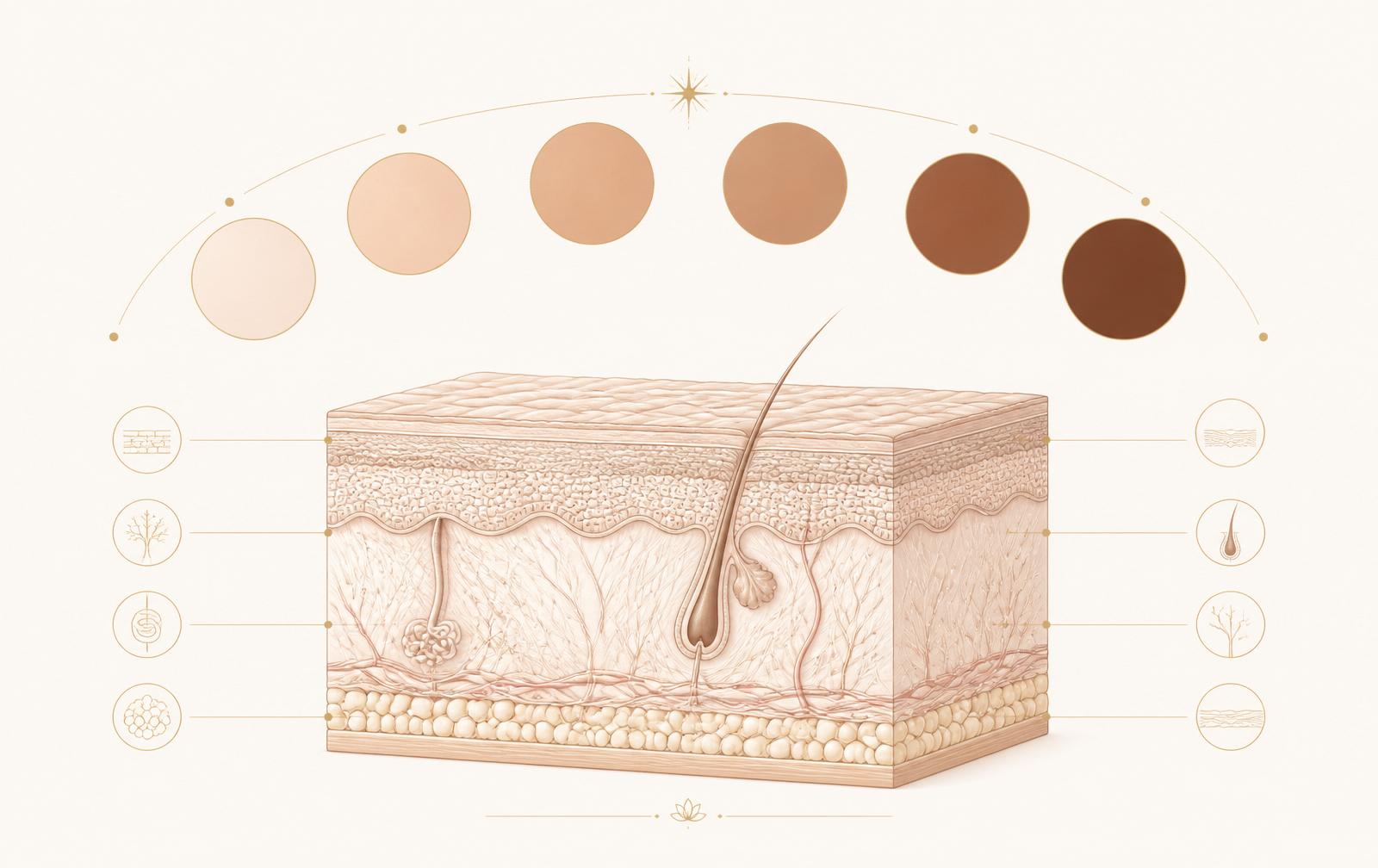
Skin tone, classified on the Fitzpatrick scale from I to VI, describes how your skin responds to ultraviolet light and, by extension, to the light and heat used in aesthetic devices. It is the single most important variable in laser safety and the main predictor of post-inflammatory hyperpigmentation.

Dubai adds a third layer. Year-round ultraviolet intensity, constant movement between extreme heat and air conditioning, and one of the most ethnically diverse patient populations in the world mean that clinics here treat the full Fitzpatrick range every single day. A protocol designed for fair European skin in winter is not a safe default here.

This guide is structured so you can read it end to end or jump directly to your profile. Every recommendation is conservative by design: where a treatment carries meaningful pigmentation risk at deeper tones, we say so rather than qualifying it away.

DHA-licensed clinicians

Dubai Healthcare City

Fitzpatrick I–VI protocols

Calibrated device settings

Assessment before treatment

No treatment without review

Section one

Understanding your skin type

Seven working skin types, what each one needs, the mistakes we see most often, and which treatments suit them.

Dry skin

A skin barrier that produces less oil than it needs, so water evaporates faster than it is replaced — very common in air-conditioned Dubai interiors.

Characteristics

  • Tightness after cleansing
  • Fine flaking around the nose, cheeks and jawline
  • Makeup clings to dry patches
  • Fine lines look more visible by late afternoon

Common concerns

  • Dullness
  • Early crepey texture
  • Sensitivity flares
  • Uneven makeup finish

Mistakes to avoid

  • Over-exfoliating in an attempt to remove flaking
  • Hot showers and foaming cleansers that strip lipids
  • Skipping moisturiser because a serum feels 'enough'

Clinical considerations

  • Barrier repair should come before any resurfacing procedure
  • Hydration-led injectables often outperform aggressive lasers here
  • Peels are used at lower strengths and longer intervals

Approach with caution

  • co2-laser
  • chemical-peel

Maintenance: A hydration treatment every 4–6 weeks, plus daily ceramide moisturiser and SPF 50, keeps a dry barrier stable between clinical sessions.

Oily skin

Sebaceous glands are highly active, giving visible shine, larger-looking pores and a thicker stratum corneum that tolerates resurfacing well.

Characteristics

  • Shine returns within a few hours of cleansing
  • Visible pores across the T-zone and cheeks
  • Blackheads and congestion
  • Makeup slides or oxidises through the day

Common concerns

  • Congestion
  • Enlarged pores
  • Breakouts
  • Uneven texture

Mistakes to avoid

  • Stripping cleansers that trigger rebound oil production
  • Skipping moisturiser entirely
  • Picking or extracting at home, which prolongs marks

Clinical considerations

  • Oily skin usually tolerates peels and microneedling well
  • Pore size is genetically fixed — treatment reduces the appearance, not the anatomy
  • Sebum control is a maintenance programme, not a single visit

Maintenance: Monthly deep-cleansing facials with a salicylic-based peel every 6–8 weeks typically holds congestion at bay.

Combination skin

An oily central panel with normal-to-dry cheeks — the most common presentation we see, and the reason zone-specific protocols matter.

Characteristics

  • Shiny T-zone with comfortable or tight cheeks
  • Congestion limited to the nose and chin
  • Different products suit different zones

Common concerns

  • Mixed congestion and dehydration
  • Uneven texture
  • Patchy pigmentation

Mistakes to avoid

  • Treating the whole face as oily
  • Using a single strength of peel across every zone

Clinical considerations

  • Zoned protocols — a stronger peel on the T-zone, hydration on the cheeks
  • Combining a resurfacing step with a hydration step in the same plan is usually ideal

Maintenance: Alternate a resurfacing session and a hydration session every 4–6 weeks so neither zone is over-treated.

Sensitive skin

A reactive barrier that stings, flushes or itches easily. Sensitivity is a response pattern, not a diagnosis — it can occur in any skin type or tone.

Characteristics

  • Stinging with active ingredients
  • Visible flushing with heat, exercise or spice
  • Redness that lingers after treatment

Common concerns

  • Redness
  • Barrier damage
  • Post-inflammatory pigmentation
  • Rosacea overlap

Mistakes to avoid

  • Layering multiple actives at once
  • Booking aggressive resurfacing without a test patch
  • Assuming discomfort means a treatment is working

Clinical considerations

  • Patch testing is standard before any energy-based device
  • Lower fluences, longer intervals and pre-treatment barrier repair
  • Anti-inflammatory prep reduces the risk of post-treatment pigmentation

Approach with caution

  • chemical-peel
  • co2-laser
  • scarlet-rf

Maintenance: Prioritise barrier-first care: gentle cleanser, ceramides, mineral SPF, and clinical treatments no more often than every 6 weeks.

Normal skin

Balanced oil and hydration with few reactive episodes. The goal here is prevention and maintaining collagen quality rather than correction.

Characteristics

  • Comfortable after cleansing
  • Even texture
  • Occasional hormonal breakouts

Common concerns

  • Early photoageing
  • Loss of glow
  • Prevention

Mistakes to avoid

  • Doing nothing until visible ageing appears
  • Inconsistent sun protection

Clinical considerations

  • Preventive collagen stimulation is more effective than late correction
  • Most treatments are suitable — sequencing matters more than selection

Maintenance: A quarterly collagen-focused treatment plus daily SPF 50 preserves skin quality long term.

Acne-prone skin

Skin with recurrent inflammatory lesions driven by sebum, follicular blockage, bacteria and inflammation — often with post-inflammatory marks left behind.

Characteristics

  • Papules, pustules or nodules in a recurring pattern
  • Post-inflammatory redness or brown marks
  • Congestion along the jawline and chin

Common concerns

  • Active acne
  • Acne scarring
  • Post-inflammatory hyperpigmentation

Mistakes to avoid

  • Starting scar treatment while acne is still active
  • Home extraction
  • Stopping a plan as soon as the skin clears

Clinical considerations

  • Active inflammation is controlled before any scar-focused resurfacing
  • Recent isotretinoin use changes timing for lasers and peels — always disclose it
  • Scar treatment is staged over months, not weeks

Approach with caution

  • dermal-fillers

Maintenance: Once clear, a maintenance peel or deep-cleansing facial every 6–8 weeks alongside prescribed topicals reduces relapse.

Mature skin

Skin with reduced collagen and elastin turnover, thinner dermis and slower repair — the priority is stimulation and structural support rather than resurfacing alone.

Characteristics

  • Static lines present at rest
  • Loss of mid-face volume
  • Crepey texture around eyes and neck
  • Slower healing after procedures

Common concerns

  • Skin laxity
  • Volume loss
  • Wrinkles
  • Uneven pigmentation

Mistakes to avoid

  • Chasing volume with filler alone rather than treating skin quality
  • Assuming stronger devices always produce better results

Clinical considerations

  • Combination planning outperforms single-modality treatment
  • Healing is slower, so intervals between sessions are extended
  • Collagen stimulators build gradually over 3–6 months

Maintenance: Plan in 6–12 month cycles: a stimulation phase, then a maintenance session every 6 months.

Section two

Fitzpatrick skin types I–VI

How each skin tone responds to ultraviolet light, laser, peels, microneedling and radiofrequency — and the protocol modifications that keep treatment safe.

Fitzpatrick Type I

Always burns, never tans.

Very fair skin, often with red or blonde hair and light eyes; freckling is common.

Pigmentation risk
Low
Healing profile
Heals predictably; redness may persist slightly longer than in deeper tones.
Laser suitability
Excellent candidate for most wavelengths, including ablative resurfacing and IPL-type devices. Hair removal can be limited when hair is very light because there is little pigment for the laser to target.
Chemical peels
Tolerates medium-depth peels with a low risk of post-inflammatory pigmentation.
Microneedling
Very well tolerated at standard depths.
Radiofrequency
Radiofrequency is safe; energy targets water and collagen rather than pigment.
Scarring risk
Low keloid risk; prolonged erythema is the more likely side effect.

Protocol modifications

  • Aggressive sun protection year-round
  • Annual skin-cancer surveillance is advisable

Fitzpatrick Type II

Burns easily, tans minimally.

Fair skin that may freckle, typically with light brown or blonde hair.

Pigmentation risk
Low
Healing profile
Reliable healing with standard aftercare.
Laser suitability
Wide device tolerance including fractional CO₂ and pigment-specific lasers.
Chemical peels
Superficial and medium peels are both appropriate.
Microneedling
Well tolerated; excellent for texture and early lines.
Radiofrequency
Safe at standard settings.
Scarring risk
Low.

Protocol modifications

  • Standard SPF 50 protocol
  • Minimal pre-conditioning required

Fitzpatrick Type III

Sometimes burns, gradually tans.

Light-to-medium skin, often Mediterranean or light Middle Eastern, darker hair and eyes.

Pigmentation risk
Low–moderate
Healing profile
Good healing; pigment can react if the skin is tanned at the time of treatment.
Laser suitability
Most devices are suitable, but never treat freshly tanned skin. Settings are adjusted downwards after sun exposure.
Chemical peels
Medium peels are used with pre-conditioning to reduce pigment rebound.
Microneedling
Highly suitable and a safe alternative to ablative lasers.
Radiofrequency
Safe and frequently preferred for tightening.
Scarring risk
Low, though post-inflammatory pigmentation becomes possible.

Protocol modifications

  • 4-week tan-free window before laser
  • Pre-treatment brightening regimen when pigmentation is present

Fitzpatrick Type IV

Rarely burns, tans easily.

Olive to light brown skin — very common across the Middle East, South Asia and the Mediterranean.

Pigmentation risk
Moderate
Healing profile
Heals well, but inflammation more readily converts into brown discolouration.
Laser suitability
Long-pulsed Nd:YAG is generally the safest hair-removal wavelength. Ablative resurfacing is possible but requires conservative density and careful pre- and post-care.
Chemical peels
Superficial to light-medium depth, layered gradually rather than in a single deep pass.
Microneedling
A first-line choice — it creates controlled injury without pigment-targeting heat.
Radiofrequency
Radiofrequency and microneedling RF are among the safest options at this tone.
Scarring risk
Slightly higher keloid tendency than Types I–III.

Protocol modifications

  • Pre-conditioning with pigment-regulating topicals
  • Lower energy, more sessions
  • Strict SPF 50 and sun avoidance after treatment

Fitzpatrick Type V

Very rarely burns, tans deeply.

Brown skin, common in South Asian, Middle Eastern, North and East African backgrounds.

Pigmentation risk
Moderate–high
Healing profile
Efficient healing, but a strong tendency to post-inflammatory hyperpigmentation if inflammation is not controlled.
Laser suitability
Restricted to pigment-safe wavelengths and conservative settings; Nd:YAG is the workhorse. Ablative CO₂ is used selectively and only with experienced hands and full pre-conditioning.
Chemical peels
Superficial peels only in most cases, with gradual build-up.
Microneedling
Preferred over ablative resurfacing for texture and scarring.
Radiofrequency
Microneedling RF is a mainstay because it bypasses melanin entirely.
Scarring risk
Higher keloid and hypertrophic scar tendency — test areas are used before treating scars.

Protocol modifications

  • Mandatory test patch for energy devices
  • Pigment-regulating prep for 2–4 weeks beforehand
  • Longer intervals between sessions

Fitzpatrick Type VI

Never burns, deeply pigmented.

Deeply pigmented brown to black skin.

Pigmentation risk
High
Healing profile
Heals reliably, but pigmentary change and keloid formation are the primary risks.
Laser suitability
Only melanin-sparing approaches: long-pulsed Nd:YAG for hair, with ablative and IPL-type devices generally avoided.
Chemical peels
Very superficial peels only, performed by clinicians experienced in skin of colour.
Microneedling
One of the safest resurfacing options available at this tone.
Radiofrequency
Radiofrequency-based tightening and microneedling RF are first-line.
Scarring risk
Highest keloid tendency of all types; scar-prone areas such as the chest and jawline are treated cautiously.

Protocol modifications

  • Test patch is non-negotiable
  • Anti-inflammatory and pigment-regulating prep
  • Conservative settings with staged sessions over months

Section three

Match your concern to the right pathway

Start from the concern, then filter by skin type and Fitzpatrick tone. Each condition below links to its dedicated clinical page.

Section four

Treatment comparison matrices

Suitability by skin type, suitability by Fitzpatrick tone, and the practical trade-offs of downtime, comfort and maintenance.

Treatment suitability by skin type
TreatmentDryOilyCombinationSensitiveNormalAcne-proneMature
HydraFacial
Chemical Peels
Microdermabrasion
Microneedling
Microneedling with PRP
Scarlet S RF Microneedling
Fractional CO₂ Laser
Laser Skin Rejuvenation
Pigmentation Laser Treatment
Laser Hair Removal
PRP Facial Therapy
Exosome Therapy
Polynucleotides (Salmon DNA / PDRN)
Profhilo
Skin Boosters
Botox (Botulinum Toxin)
Dermal Fillers
Collagen Stimulators (Sculptra-type)
Collagen Thread Lifting
Treatment suitability by Fitzpatrick skin tone
TreatmentIIIIIIIVVVIPigment risk
HydraFacialLow
Chemical PeelsModerate
MicrodermabrasionLow
MicroneedlingLow
Microneedling with PRPLow
Scarlet S RF MicroneedlingLow
Fractional CO₂ LaserHigh
Laser Skin RejuvenationModerate
Pigmentation Laser TreatmentModerate
Laser Hair RemovalModerate
PRP Facial TherapyLow
Exosome TherapyLow
Polynucleotides (Salmon DNA / PDRN)Low
ProfhiloLow
Skin BoostersLow
Botox (Botulinum Toxin)Low
Dermal FillersLow
Collagen Stimulators (Sculptra-type)Low
Collagen Thread LiftingLow
PRP for Hair LossLow
Hair Exosome TherapyLow
IV TherapyLow
Downtime, comfort and maintenance at a glance
TreatmentDowntimeComfort (1–5)Maintenance
HydraFacialNone1/5Every 4 weeks, or before events.
Chemical Peels1-2 days2/5A course of 3–6 sessions every 3–4 weeks, then quarterly.
MicrodermabrasionNone1/5Every 3–4 weeks in a short course, then as needed.
Microneedling1-2 days2/53–6 sessions every 4 weeks, then every 6 months.
Microneedling with PRP1-2 days3/53 sessions 4–6 weeks apart, then every 6–12 months.
Scarlet S RF Microneedling1-2 days3/53 sessions 4–6 weeks apart, then annually.
Fractional CO₂ Laser5-7 days4/51–3 sessions 6–8 weeks apart, then as required.
Laser Skin Rejuvenation1-2 days2/53–5 sessions every 3–4 weeks, then twice yearly.
Pigmentation Laser Treatment1-2 days2/53–6 sessions every 3–4 weeks, then maintenance twice yearly.
Laser Hair RemovalNone2/56–8 sessions 4–6 weeks apart, then top-ups 1–2 times a year.
PRP Facial Therapy1-2 days2/53 sessions monthly, then every 6–12 months.
Exosome TherapyNone2/53 sessions 2–4 weeks apart, then twice yearly.
Polynucleotides (Salmon DNA / PDRN)1-2 days3/53–4 sessions 2–3 weeks apart, then every 6 months.
Profhilo1-2 days2/52 sessions 4 weeks apart, then every 6 months.
Skin Boosters1-2 days2/52–3 sessions monthly, then every 6 months.
Botox (Botulinum Toxin)None2/5Every 3–4 months.
Dermal Fillers1-2 days2/5Every 9–18 months depending on product and area.
Collagen Stimulators (Sculptra-type)1-2 days3/52–3 sessions 4–6 weeks apart, results build over 3–6 months, then annually.
Collagen Thread Lifting5-7 days3/5Every 12–18 months.
PRP for Hair LossNone3/53–4 sessions monthly, then every 4–6 months.
Hair Exosome TherapyNone2/53 sessions 2–4 weeks apart, then twice yearly.
IV TherapyNone2/5As advised after medical assessment.
Teeth WhiteningNone1/5Every 12–18 months with good oral hygiene.

Best for acne

  • HydraFacialevery 4 weeks, or before events.
  • Chemical Peelsa course of 3–6 sessions every 3–4 weeks, then quarterly.
  • Microneedling3–6 sessions every 4 weeks, then every 6 months.
  • Laser Skin Rejuvenation3–5 sessions every 3–4 weeks, then twice yearly.

Best for ageing

  • Profhilo2 sessions 4 weeks apart, then every 6 months.
  • Collagen Stimulators (Sculptra-type)2–3 sessions 4–6 weeks apart, results build over 3–6 months, then annually.
  • Botox (Botulinum Toxin)every 3–4 months.
  • Scarlet S RF Microneedling3 sessions 4–6 weeks apart, then annually.

Best for texture

  • Microneedling3–6 sessions every 4 weeks, then every 6 months.
  • Fractional CO₂ Laser1–3 sessions 6–8 weeks apart, then as required.
  • Chemical Peelsa course of 3–6 sessions every 3–4 weeks, then quarterly.
  • Microdermabrasionevery 3–4 weeks in a short course, then as needed.

Best for collagen stimulation

  • Collagen Stimulators (Sculptra-type)2–3 sessions 4–6 weeks apart, results build over 3–6 months, then annually.
  • Scarlet S RF Microneedling3 sessions 4–6 weeks apart, then annually.
  • Microneedling with PRP3 sessions 4–6 weeks apart, then every 6–12 months.
  • Polynucleotides (Salmon DNA / PDRN)3–4 sessions 2–3 weeks apart, then every 6 months.

Section five

Interactive treatment finder

Answer five questions to see an indicative, education-first pathway based on the same clinical filters our doctors apply.

Interactive treatment finder

Build your skin profile

1. Skin type
2. Skin tone (Fitzpatrick)
3. Primary concern
4. Age group
5. Downtime preference

Select one option in each of the five groups to see an indicative pathway.

Section six

Treatment library

Every treatment in this guide, with ideal skin types, Fitzpatrick suitability, contraindications, downtime, comfort and maintenance.

HydraFacialSkin · no downtime · low pigmentation risk

A medical-grade cleanse, gentle exfoliation, painless extraction and antioxidant infusion in one session. It is the standard preparation step before most clinical pathways because it clears the surface without inflaming it.

Ideal skin types
Dry, Oily, Combination, Sensitive, Normal, Acne-prone, Mature
Ideal Fitzpatrick types
I, II, III, IV, V, VI
Best indications
Dull skin, Large pores, Uneven texture, Acne
Contraindications
Active infection or cold sore outbreak · Open wounds · Recent deep resurfacing
Downtime
None
Comfort level
1/5
Maintenance
Every 4 weeks, or before events.
Combines well with
Chemical Peels, Skin Boosters, Microneedling

Common questions

Can I have a HydraFacial before an event?
Yes — it is one of the few treatments that can be performed the day before an event, as there is no visible downtime.
Is it safe for deeper skin tones?
Yes. It uses no heat or light energy, so it carries no pigmentation risk at any Fitzpatrick type.
Read the full HydraFacial page
Chemical PeelsSkin · 1-2 days downtime · moderate pigmentation risk

Controlled application of acids to accelerate cell turnover, refine texture and lift surface pigmentation. Depth and acid choice are matched to skin tone — deeper tones are treated with gradual, superficial layering rather than a single strong pass.

Ideal skin types
Oily, Combination, Normal, Acne-prone
Ideal Fitzpatrick types
I, II, III, IV
Best indications
Acne, Pigmentation, Melasma, Dull skin, Uneven texture, Large pores
Contraindications
Pregnancy (depending on agent) · Active infection · Recent isotretinoin · Fresh tan
Downtime
1-2 days
Comfort level
2/5
Maintenance
A course of 3–6 sessions every 3–4 weeks, then quarterly.
Combines well with
HydraFacial, Microneedling, Skin Boosters

Common questions

Will my skin visibly peel?
Superficial peels usually cause light flaking for 2–3 days. Medium peels shed more visibly for around 5 days.
Are peels safe for Fitzpatrick V–VI?
Superficial peels can be, with pigment-regulating preparation beforehand. Medium-depth peels are generally avoided at these tones.
Read the full Chemical Peels page
MicrodermabrasionSkin · no downtime · low pigmentation risk

Mechanical resurfacing that removes the outermost layer of dead cells to brighten dull skin and improve product absorption, with no heat and no recovery period.

Ideal skin types
Normal, Combination, Oily, Dry
Ideal Fitzpatrick types
I, II, III, IV, V
Best indications
Dull skin, Uneven texture, Large pores
Contraindications
Active acne with inflamed lesions · Rosacea flare · Fragile or thinned skin
Downtime
None
Comfort level
1/5
Maintenance
Every 3–4 weeks in a short course, then as needed.
Combines well with
HydraFacial, Chemical Peels

Common questions

How is it different from a HydraFacial?
Microdermabrasion is purely mechanical exfoliation; a HydraFacial adds hydration, extraction and antioxidant infusion in the same session.
Read the full Microdermabrasion page
MicroneedlingSkin · 1-2 days downtime · low pigmentation risk

Fine needles create controlled micro-channels that trigger collagen remodelling without targeting melanin. Because no light or heat is aimed at pigment, it is one of the safest resurfacing options for deeper skin tones.

Ideal skin types
Oily, Combination, Normal, Acne-prone, Mature, Dry
Ideal Fitzpatrick types
I, II, III, IV, V, VI
Best indications
Acne scars, Large pores, Uneven texture, Fine lines, Dull skin
Contraindications
Active acne infection · Pregnancy · Keloid history (test area first) · Recent isotretinoin
Downtime
1-2 days
Comfort level
2/5
Maintenance
3–6 sessions every 4 weeks, then every 6 months.
Combines well with
PRP Facial Therapy, Exosome Therapy, HydraFacial, Polynucleotides (Salmon DNA / PDRN)

Common questions

Does microneedling help acne scars?
Yes — it is a first-line option for rolling and boxcar scars, particularly in skin of colour where ablative lasers carry more pigmentation risk.
How long is the redness?
Most people look flushed for 24–48 hours, similar to mild sunburn.
Read the full Microneedling page
Microneedling with PRPRegenerative · 1-2 days downtime · low pigmentation risk

Microneedling combined with platelet-rich plasma drawn from your own blood. The growth factors in PRP are delivered through the micro-channels to support repair, and the autologous nature of the product means no allergy risk.

Ideal skin types
Acne-prone, Combination, Normal, Mature, Sensitive
Ideal Fitzpatrick types
I, II, III, IV, V, VI
Best indications
Acne scars, Uneven texture, Fine lines, Dull skin
Contraindications
Blood or clotting disorders · Active infection · Pregnancy · Certain anticoagulant medication
Downtime
1-2 days
Comfort level
3/5
Maintenance
3 sessions 4–6 weeks apart, then every 6–12 months.
Combines well with
Microneedling, Exosome Therapy, Polynucleotides (Salmon DNA / PDRN)

Common questions

Is PRP better than microneedling alone?
Adding PRP is associated with faster recovery and improved collagen response in published studies, though results vary between individuals.
Read the full Microneedling with PRP page
Scarlet S RF MicroneedlingSkin · 1-2 days downtime · low pigmentation risk

Insulated microneedles deliver radiofrequency energy into the dermis. Because the energy targets water and collagen rather than melanin, it tightens and remodels safely across the full Fitzpatrick range.

Ideal skin types
Mature, Combination, Oily, Normal, Acne-prone
Ideal Fitzpatrick types
I, II, III, IV, V, VI
Best indications
Skin laxity, Acne scars, Large pores, Fine lines, Wrinkles, Uneven texture
Contraindications
Pacemaker or implanted electronic device · Pregnancy · Active infection · Metal implants in the treatment area
Downtime
1-2 days
Comfort level
3/5
Maintenance
3 sessions 4–6 weeks apart, then annually.
Combines well with
Profhilo, Skin Boosters, Botox (Botulinum Toxin)

Common questions

Is RF microneedling safe for brown skin?
Yes. Radiofrequency bypasses melanin, which is why it is often preferred over ablative laser for Fitzpatrick IV–VI.
When do I see tightening?
Early smoothing appears in 3–4 weeks; collagen remodelling continues for around 3 months.
Read the full Scarlet S RF Microneedling page
Fractional CO₂ LaserLaser · 5-7 days downtime · high pigmentation risk

Ablative fractional resurfacing that removes microscopic columns of tissue to drive a strong collagen response. The most powerful option for scarring and texture, and the one most dependent on correct skin-tone assessment.

Ideal skin types
Normal, Combination, Oily, Acne-prone, Mature
Ideal Fitzpatrick types
I, II, III
Best indications
Acne scars, Wrinkles, Uneven texture, Large pores, Pigmentation
Contraindications
Recent isotretinoin · Active infection · Pregnancy · Recent tan · Keloid history
Downtime
5-7 days
Comfort level
4/5
Maintenance
1–3 sessions 6–8 weeks apart, then as required.
Combines well with
PRP Facial Therapy, Polynucleotides (Salmon DNA / PDRN), HydraFacial

Common questions

Can CO₂ laser be used on darker skin?
It can be used selectively at Fitzpatrick IV with conservative density and full pre-conditioning, but RF microneedling is usually the safer choice at IV–VI.
How long is recovery?
Expect 5–7 days of visible healing, with residual pinkness for a few weeks.
Read the full Fractional CO₂ Laser page
Laser Skin RejuvenationLaser · 1-2 days downtime · moderate pigmentation risk

Non-ablative laser that improves tone, superficial pigmentation and vascular redness with minimal recovery. Device and wavelength selection is matched to your Fitzpatrick type.

Ideal skin types
Normal, Combination, Dry, Mature
Ideal Fitzpatrick types
I, II, III, IV
Best indications
Pigmentation, Dull skin, Uneven texture, Fine lines, Rosacea
Contraindications
Fresh tan · Photosensitising medication · Pregnancy · Active infection
Downtime
1-2 days
Comfort level
2/5
Maintenance
3–5 sessions every 3–4 weeks, then twice yearly.
Combines well with
HydraFacial, Skin Boosters

Common questions

Will it remove melasma permanently?
No treatment removes melasma permanently. Laser can reduce visible pigment substantially, but melasma is a long-term condition that needs ongoing sun protection and maintenance.
Read the full Laser Skin Rejuvenation page
Pigmentation Laser TreatmentLaser · 1-2 days downtime · moderate pigmentation risk

Targeted pigment-specific laser for sun spots, post-inflammatory marks and stubborn discolouration, always paired with a topical regimen and strict sun protection.

Ideal skin types
Normal, Combination, Dry, Oily, Mature
Ideal Fitzpatrick types
I, II, III, IV
Best indications
Pigmentation, Melasma, Dull skin
Contraindications
Recent sun exposure · Pregnancy · Photosensitising medication
Downtime
1-2 days
Comfort level
2/5
Maintenance
3–6 sessions every 3–4 weeks, then maintenance twice yearly.
Combines well with
Chemical Peels, HydraFacial, Skin Boosters

Common questions

Why does pigmentation come back?
Melanocytes remain active. Without daily SPF and maintenance, UV and heat re-stimulate pigment production — especially in Dubai's climate.
Read the full Pigmentation Laser Treatment page
Laser Hair RemovalLaser · no downtime · moderate pigmentation risk

Laser energy is absorbed by the pigment in the hair follicle to reduce regrowth over a course of sessions. Long-pulsed Nd:YAG allows safe treatment of deeper skin tones that older devices could not treat.

Ideal skin types
Dry, Oily, Combination, Sensitive, Normal, Acne-prone, Mature
Ideal Fitzpatrick types
I, II, III, IV, V, VI
Best indications
Unwanted hair
Contraindications
Pregnancy · Recent tan · Photosensitising medication · Active skin infection
Downtime
None
Comfort level
2/5
Maintenance
6–8 sessions 4–6 weeks apart, then top-ups 1–2 times a year.
Combines well with
HydraFacial

Common questions

Is laser hair removal safe for dark skin?
Yes, with the correct device. Nd:YAG wavelengths pass safely around surface melanin, which is why device choice matters more than anything else at Fitzpatrick V–VI.
Does it work on white or grey hair?
No. Without pigment in the hair shaft the laser has no target, so alternatives are discussed instead.
Read the full Laser Hair Removal page
PRP Facial TherapyRegenerative · 1-2 days downtime · low pigmentation risk

Platelet-rich plasma concentrated from your own blood and reintroduced into the skin to support repair, hydration and collagen activity. Suitable across all skin tones because it involves no heat or light.

Ideal skin types
Sensitive, Dry, Mature, Normal, Combination
Ideal Fitzpatrick types
I, II, III, IV, V, VI
Best indications
Dull skin, Fine lines, Acne scars, Uneven texture
Contraindications
Blood disorders · Active infection · Pregnancy
Downtime
1-2 days
Comfort level
2/5
Maintenance
3 sessions monthly, then every 6–12 months.
Combines well with
Microneedling, Polynucleotides (Salmon DNA / PDRN), Skin Boosters

Common questions

Is PRP painful?
A blood draw plus superficial injections; topical numbing is used and most patients describe it as mild.
Read the full PRP Facial Therapy page
Exosome TherapyRegenerative · no downtime · low pigmentation risk

Signalling molecules applied after a micro-channelling step to support cell communication, calm inflammation and improve recovery. Frequently used to shorten redness after microneedling or laser.

Ideal skin types
Sensitive, Dry, Mature, Normal, Acne-prone, Combination
Ideal Fitzpatrick types
I, II, III, IV, V, VI
Best indications
Dull skin, Uneven texture, Fine lines, Acne scars
Contraindications
Active infection · Pregnancy · Known hypersensitivity
Downtime
None
Comfort level
2/5
Maintenance
3 sessions 2–4 weeks apart, then twice yearly.
Combines well with
Microneedling, Scarlet S RF Microneedling, Fractional CO₂ Laser

Common questions

Why combine exosomes with microneedling?
The micro-channels improve delivery, and the anti-inflammatory effect typically shortens post-treatment redness.
Read the full Exosome Therapy page
Polynucleotides (Salmon DNA / PDRN)Regenerative · 1-2 days downtime · low pigmentation risk

Purified polynucleotide chains injected into the dermis to support hydration, tissue repair and elasticity. Particularly useful for thin, sensitive or crepey skin including the under-eye area.

Ideal skin types
Sensitive, Dry, Mature, Normal
Ideal Fitzpatrick types
I, II, III, IV, V, VI
Best indications
Fine lines, Dull skin, Uneven texture, Skin laxity
Contraindications
Fish allergy · Pregnancy · Active infection · Autoimmune flare
Downtime
1-2 days
Comfort level
3/5
Maintenance
3–4 sessions 2–3 weeks apart, then every 6 months.
Combines well with
Skin Boosters, Profhilo, Microneedling

Common questions

Are polynucleotides a filler?
No. They add no volume — they act on tissue quality, hydration and repair.
Read the full Polynucleotides (Salmon DNA / PDRN) page
ProfhiloInjectable · 1-2 days downtime · low pigmentation risk

A highly concentrated, stabiliser-free hyaluronic acid that spreads through the tissue to hydrate and stimulate collagen and elastin. It improves skin quality rather than adding shape or volume.

Ideal skin types
Dry, Mature, Normal, Sensitive, Combination
Ideal Fitzpatrick types
I, II, III, IV, V, VI
Best indications
Fine lines, Dull skin, Skin laxity, Uneven texture
Contraindications
Pregnancy and breastfeeding · Active infection · Autoimmune flare
Downtime
1-2 days
Comfort level
2/5
Maintenance
2 sessions 4 weeks apart, then every 6 months.
Combines well with
Skin Boosters, Scarlet S RF Microneedling, Botox (Botulinum Toxin)

Common questions

Will Profhilo change my face shape?
No. It is not designed to add contour or volume — it improves hydration and firmness of the skin itself.
Read the full Profhilo page
Skin BoostersInjectable · 1-2 days downtime · low pigmentation risk

Micro-injections of hyaluronic acid and, in some formulations, antioxidants and amino acids, placed superficially to restore hydration and light reflection. A comfortable option for glow with minimal recovery.

Ideal skin types
Dry, Normal, Mature, Sensitive, Combination
Ideal Fitzpatrick types
I, II, III, IV, V, VI
Best indications
Dull skin, Fine lines, Uneven texture, Large pores
Contraindications
Pregnancy · Active infection · Known hypersensitivity
Downtime
1-2 days
Comfort level
2/5
Maintenance
2–3 sessions monthly, then every 6 months.
Combines well with
Profhilo, HydraFacial, Polynucleotides (Salmon DNA / PDRN)

Common questions

How soon will I see glow?
Most patients notice improved light reflection at 2–3 weeks, after the initial injection points settle.
Read the full Skin Boosters page
Botox (Botulinum Toxin)Injectable · no downtime · low pigmentation risk

Precisely dosed botulinum toxin that softens the muscle activity creating dynamic lines. Used preventively in younger patients and correctively alongside skin-quality treatments in mature skin.

Ideal skin types
Normal, Combination, Oily, Dry, Mature, Sensitive
Ideal Fitzpatrick types
I, II, III, IV, V, VI
Best indications
Fine lines, Wrinkles
Contraindications
Pregnancy and breastfeeding · Neuromuscular disorders · Active infection at the site
Downtime
None
Comfort level
2/5
Maintenance
Every 3–4 months.
Combines well with
Profhilo, Skin Boosters, Dermal Fillers

Common questions

Will I look frozen?
Not with conservative, anatomy-led dosing. The aim is softened movement, not absent expression.
Read the full Botox (Botulinum Toxin) page
Dermal FillersInjectable · 1-2 days downtime · low pigmentation risk

Hyaluronic acid gels placed at specific depths to restore lost volume and support facial structure. Results are long-lasting rather than permanent, and the product can be dissolved if adjustment is needed.

Ideal skin types
Mature, Normal, Dry, Combination
Ideal Fitzpatrick types
I, II, III, IV, V, VI
Best indications
Wrinkles, Skin laxity
Contraindications
Pregnancy and breastfeeding · Active infection · Autoimmune flare · Known hypersensitivity
Downtime
1-2 days
Comfort level
2/5
Maintenance
Every 9–18 months depending on product and area.
Combines well with
Botox (Botulinum Toxin), Profhilo, Collagen Stimulators (Sculptra-type)

Common questions

Is filler permanent?
No. Hyaluronic acid fillers are gradually broken down by the body and can also be dissolved by a clinician if required.
Read the full Dermal Fillers page
Collagen Stimulators (Sculptra-type)Injectable · 1-2 days downtime · low pigmentation risk

Biostimulatory injectables that prompt your own collagen production over several months, restoring firmness gradually rather than adding immediate volume.

Ideal skin types
Mature, Normal, Dry, Combination
Ideal Fitzpatrick types
I, II, III, IV, V, VI
Best indications
Skin laxity, Wrinkles, Fine lines
Contraindications
Pregnancy · Autoimmune flare · Active infection · Keloid history in the area
Downtime
1-2 days
Comfort level
3/5
Maintenance
2–3 sessions 4–6 weeks apart, results build over 3–6 months, then annually.
Combines well with
Profhilo, Scarlet S RF Microneedling, Collagen Thread Lifting

Common questions

Why are results not immediate?
The product works by stimulating collagen, so firmness develops progressively across 3–6 months.
Read the full Collagen Stimulators (Sculptra-type) page
Collagen Thread LiftingInjectable · 5-7 days downtime · low pigmentation risk

Absorbable threads placed under the skin to reposition tissue and stimulate collagen along their path. A structural option for mild to moderate laxity where surgery is not wanted.

Ideal skin types
Mature, Normal, Combination
Ideal Fitzpatrick types
I, II, III, IV, V, VI
Best indications
Skin laxity, Wrinkles
Contraindications
Pregnancy · Active infection · Autoimmune disease · Keloid tendency
Downtime
5-7 days
Comfort level
3/5
Maintenance
Every 12–18 months.
Combines well with
Collagen Stimulators (Sculptra-type), Profhilo, Scarlet S RF Microneedling

Common questions

Is a thread lift the same as a facelift?
No. It repositions tissue modestly with far less recovery, and the effect is temporary rather than surgical.
Read the full Collagen Thread Lifting page
PRP for Hair LossHair · no downtime · low pigmentation risk

Platelet-rich plasma injected into the scalp to support follicle function in early to moderate thinning. Safe across all skin tones and often combined with exosomes or growth-factor protocols.

Ideal skin types
Dry, Oily, Combination, Sensitive, Normal, Acne-prone, Mature
Ideal Fitzpatrick types
I, II, III, IV, V, VI
Best indications
Hair loss
Contraindications
Blood disorders · Active scalp infection · Pregnancy
Downtime
None
Comfort level
3/5
Maintenance
3–4 sessions monthly, then every 4–6 months.
Combines well with
Hair Exosome Therapy

Common questions

When will I see less shedding?
Reduced shedding is often reported by 8–12 weeks; visible density changes take 4–6 months.
Read the full PRP for Hair Loss page
Hair Exosome TherapyHair · no downtime · low pigmentation risk

Scalp application of signalling molecules to support the follicular environment, typically layered with PRP or growth-factor mesotherapy in a staged programme.

Ideal skin types
Dry, Oily, Combination, Sensitive, Normal, Mature
Ideal Fitzpatrick types
I, II, III, IV, V, VI
Best indications
Hair loss
Contraindications
Active scalp infection · Pregnancy
Downtime
None
Comfort level
2/5
Maintenance
3 sessions 2–4 weeks apart, then twice yearly.
Combines well with
PRP for Hair Loss

Common questions

Can exosomes replace PRP?
They are usually complementary. Your clinician will advise which sequence suits your pattern of loss.
Read the full Hair Exosome Therapy page
IV TherapyWellness · no downtime · low pigmentation risk

Clinician-supervised intravenous hydration and micronutrient support. It is a wellness adjunct — supportive of general recovery and hydration, not a substitute for skin-directed treatment.

Ideal skin types
Dry, Oily, Combination, Sensitive, Normal, Acne-prone, Mature
Ideal Fitzpatrick types
I, II, III, IV, V, VI
Best indications
Dull skin
Contraindications
Kidney or cardiac disease without clearance · Pregnancy without clearance · Certain medications
Downtime
None
Comfort level
2/5
Maintenance
As advised after medical assessment.
Combines well with
HydraFacial

Common questions

Will IV therapy brighten my skin?
It supports hydration and general wellbeing. Visible pigmentation or texture change requires skin-directed treatment.
Read the full IV Therapy page
Teeth WhiteningDental · no downtime · low pigmentation risk

Included here only for completeness: whitening is a dental procedure and is unrelated to skin type or Fitzpatrick classification. It is often booked alongside facial treatments before weddings and events.

Ideal skin types
Dry, Oily, Combination, Sensitive, Normal, Acne-prone, Mature
Ideal Fitzpatrick types
I, II, III, IV, V, VI
Best indications
Dental — unrelated to skin classification
Contraindications
Untreated decay or gum disease · Pregnancy · Severe enamel sensitivity
Downtime
None
Comfort level
1/5
Maintenance
Every 12–18 months with good oral hygiene.
Combines well with
Usually performed on its own

Common questions

Does skin tone affect whitening results?
No. Whitening depends on enamel and dentine, not skin type or Fitzpatrick classification.
Read the full Teeth Whitening page

Section seven

Treatment safety by skin tone

The safety questions that matter most in a city where Fitzpatrick IV–VI skin is treated every day.

Why laser settings change with skin tone

Many devices target melanin. In deeper skin, melanin is present throughout the epidermis, not only in the target, so identical settings deliver energy where it is not wanted. Safe treatment at Fitzpatrick IV–VI means longer wavelengths (typically Nd:YAG), longer pulse durations, lower fluences, aggressive cooling and staged sessions.

Post-inflammatory hyperpigmentation

This is the most common adverse outcome in pigmented skin and is caused by inflammation, not by treatment itself. It can follow a burn, an over-aggressive peel, or simply an untreated acne lesion. It is usually temporary, but resolution can take months, which is why conservative parameters are chosen deliberately.

Keloid and hypertrophic scarring risk

Risk rises at Fitzpatrick V–VI and with a personal or family history. Where risk is identified, ablative resurfacing and deep needling are usually avoided in favour of non-wounding modalities, and a test area is treated first.

Test patching

For any energy-based treatment at Fitzpatrick IV and above, a discreet test area is treated and reviewed before a full session. This adds one visit and removes most of the risk.

Tanning and sun exposure

Recent tanning changes the melanin target and makes previously safe settings unsafe. A four-week tan-free interval before and after laser and medium-depth peels is standard practice in Dubai, including tan from a single beach weekend.

Medication and medical history

Isotretinoin, photosensitising medication, anticoagulants, autoimmune conditions, pregnancy and breastfeeding all change what can be performed safely. A full history is taken at every consultation — not as paperwork, but because it changes the plan.

Warning signs of an unsafe clinic

  • No Fitzpatrick assessment or medical history before an energy-based treatment
  • The same laser setting offered to every patient regardless of skin tone
  • Treatment performed by a non-licensed practitioner without physician oversight
  • Pressure to buy a package before any assessment
  • Guarantees of permanent or complete results
  • No written aftercare and no follow-up appointment

Section eight

Recovery, downtime and aftercare

What to expect, when to plan treatments around your calendar, and the aftercare that protects your result in a high-UV climate.

No downtime

HydraFacial, microdermabrasion, laser hair removal, Botox, skin boosters, exosome infusion and IV therapy. You can return to work immediately; makeup is usually permitted the same or next day.

One to five days

Microneedling, light and medium peels, RF microneedling, dermal fillers and Profhilo. Expect redness, mild swelling and occasional flaking. Plan four to seven days ahead of an event.

Five to fourteen days

Fractional CO₂ resurfacing and deeper combined protocols. Visible healing for around a week, residual pinkness for several weeks. Best scheduled outside peak sun exposure and travel.

Standard aftercare

  • Gentle, non-foaming cleanser and a ceramide moisturiser for 5–7 days
  • SPF 50 every morning, reapplied when outdoors
  • No sauna, steam, gym or swimming for 48–72 hours (longer after resurfacing)
  • Pause retinoids, acids and scrubs until your clinician confirms
  • No picking, peeling or exfoliating healing skin

Dubai-specific factors

  • UV index stays high year-round — pigmentation results depend on daily SPF
  • Air conditioning dehydrates skin and slows barrier recovery; increase hydration
  • Heat and humidity can prolong post-treatment redness in summer
  • Beach and pool plans should be declared before booking energy-based treatments
  • Frequent travellers should plan resurfacing around flights and sun exposure

Section nine

Combination pathways and sequencing

Real-world pathways showing how treatments are staged. Sequence matters as much as selection — control inflammation, prepare the skin, then stimulate, then refine.

Acne scarring in skin of colour

  • Combination skin
  • Fitzpatrick IV
  • Acne scars
  • Minimal downtime
  1. 1HydraFacial Clear congestion and settle the surface
  2. 2Chemical Peels Light layered peels to even post-inflammatory marks
  3. 3Microneedling Collagen remodelling without pigment-targeting energy
  4. 4Scarlet S RF Microneedling Deeper remodelling for indented scars

Maintenance every 6 months with strict SPF 50 to prevent new post-inflammatory pigmentation.

Melasma and stubborn pigmentation

  • Combination skin
  • Fitzpatrick III–V
  • Melasma
  • Low downtime
  1. 1HydraFacial Barrier-safe preparation
  2. 2Chemical Peels Superficial peels alongside prescribed topicals
  3. 3Pigmentation Laser Treatment Conservative, staged sessions once pigment is stable
  4. 4Skin Boosters Hydration support to reduce inflammation-driven relapse

Melasma is managed, not cured. Daily SPF and heat avoidance are as important as any device.

Early prevention in your late twenties

  • Normal skin
  • Fitzpatrick II–IV
  • Fine lines
  • No downtime
  1. 1HydraFacial Regular clarity and hydration
  2. 2Skin Boosters Restore light reflection and hydration
  3. 3Botox (Botulinum Toxin) Conservative dosing for developing dynamic lines
  4. 4Microneedling Quarterly collagen support

Prevention costs less and delivers a more natural trajectory than late correction.

Laxity and volume loss after 45

  • Mature skin
  • Fitzpatrick I–VI
  • Skin laxity
  • Up to one week downtime
  1. 1Profhilo Improve skin quality before structural work
  2. 2Collagen Stimulators (Sculptra-type) Rebuild firmness gradually over 3–6 months
  3. 3Scarlet S RF Microneedling Tighten and remodel the dermis
  4. 4Dermal Fillers Restore support where volume has been lost

Sequencing matters: skin quality first, then structure, then refinement.

Persistent hair thinning

  • Any skin type
  • Fitzpatrick I–VI
  • Hair loss
  • No downtime
  1. 1PRP for Hair Loss Monthly induction phase
  2. 2Hair Exosome Therapy Layered support for the follicular environment
  3. 3PRP for Hair Loss Maintenance every 4–6 months

Blood tests and a scalp assessment come first — thinning often has a treatable medical driver.

Section ten

Frequently asked questions

42 questions our clinicians are asked most often about skin type, skin tone, safety, downtime and sequencing.

How do I know my skin type?
Cleanse, apply nothing for two hours and observe. Tightness suggests dry skin, shine across the whole face suggests oily, shine limited to the T-zone suggests combination, and stinging or flushing suggests sensitivity. A clinician confirms this alongside pore size, hydration and barrier assessment.
Can my skin type change?
Yes. Hormones, medication, climate, air conditioning and age all shift oil production and barrier function. Many people who were oily in their twenties become combination or dry later.
What is the Fitzpatrick scale?
A dermatological classification from I to VI based on how your skin responds to ultraviolet light. It predicts burning and tanning tendency and, critically, how safely your skin can be treated with light- and heat-based devices.
Why does my Fitzpatrick type matter more than my skin colour?
Because it describes how your skin reacts, not just how it looks. Two people with similar complexions can respond differently to laser, and the reaction pattern is what determines safe settings.
Is laser safe for brown and dark skin?
Yes, with the correct wavelength and settings. Long-pulsed Nd:YAG is the established choice for hair removal in Fitzpatrick V–VI, and radiofrequency-based devices avoid melanin altogether.
View more frequently asked questions (37)
Why do clinics refuse certain lasers for darker skin?
Devices that target pigment cannot always distinguish between hair pigment and skin pigment. Using the wrong device on deeply pigmented skin risks burns and long-lasting discolouration.
What is post-inflammatory hyperpigmentation?
Brown discolouration that appears after inflammation — a spot, a burn or an over-aggressive treatment. It is more common at Fitzpatrick IV–VI and is the main reason conservative settings are used.
How long does post-inflammatory pigmentation take to fade?
Often three to twelve months without treatment. Topical regimens and gentle resurfacing can shorten this, but sun protection determines the outcome more than anything else.
Can I have treatment on tanned skin?
Not for most laser and peel procedures. A four-week tan-free window is standard, because treating tanned skin substantially raises the risk of burns and pigmentation.
Which treatments are safest for sensitive skin?
Hydration-led options such as HydraFacial, polynucleotides, skin boosters and Profhilo, alongside barrier repair. Energy devices can be used, but at reduced settings with a test patch.
Does microneedling work for acne scars?
Yes. It is a first-line option, especially for rolling and boxcar scars, and it is safe across the full Fitzpatrick range because it uses no light or heat.
Is CO₂ laser better than microneedling?
It is more powerful for deep scarring in Fitzpatrick I–III, but that power carries higher pigmentation risk. In deeper tones, RF microneedling frequently achieves comparable improvement with a safer profile.
How many sessions will I need?
Most collagen-based treatments need three to six sessions spaced four weeks apart, followed by maintenance. Single sessions rarely achieve lasting structural change.
Are results permanent?
No aesthetic treatment is permanent. Results are long-lasting when maintained, but skin continues to age and treatments are repeated on a planned schedule.
Which treatments have no downtime?
HydraFacial, microdermabrasion, laser hair removal, Botox, exosome infusion and IV therapy typically allow an immediate return to normal activity.
What downtime should I expect from microneedling?
Redness resembling mild sunburn for 24–48 hours, occasionally with light flaking on day three.
What downtime should I expect from fractional CO₂?
Five to seven days of visible healing, with residual pinkness for several weeks depending on density and depth.
How painful are these treatments?
Most are described as mild. Topical anaesthetic is used for microneedling, RF microneedling and laser resurfacing, and injectable treatments use very fine needles with numbing.
Can I combine treatments in one visit?
Frequently, yes — for example microneedling with PRP, or Botox with skin boosters. Combinations are planned so recovery periods do not overlap unsafely.
What order should treatments be done in?
As a rule: control inflammation, prepare and hydrate the skin, then resurface or stimulate collagen, then refine with injectables. Reversing that order compromises results.
Should I treat acne or acne scars first?
Always control active acne first. Resurfacing inflamed skin risks worsening both scarring and pigmentation.
Can I have treatments while pregnant?
Injectables, most peels, laser and radiofrequency are avoided during pregnancy and breastfeeding. Gentle facials and barrier care are generally suitable — always tell your clinician.
Can I have laser if I am on isotretinoin?
Timing must be discussed with your doctor. Resurfacing and peels are usually postponed until a defined period after the course finishes.
Does sun exposure in Dubai change my treatment plan?
Yes. High year-round UV and heat raise pigmentation risk, so plans often favour lower-risk modalities, and sessions may be scheduled around travel and outdoor activity.
Is SPF really necessary indoors?
Daily SPF 50 is advised, and reapplication matters near windows and outdoors. Without it, pigmentation results are difficult to hold.
Do I need different treatments in summer?
Often the intensity is adjusted rather than the plan changed. Heat and UV exposure increase pigmentation risk, so more aggressive resurfacing is frequently deferred.
Are filler results reversible?
Hyaluronic acid fillers can be dissolved by a clinician if adjustment is needed. Biostimulators are not reversible, which is why conservative dosing is used.
What is the difference between Profhilo and filler?
Filler adds volume and structure. Profhilo adds no shape — it improves hydration, firmness and skin quality.
What is the difference between PRP and exosomes?
PRP is prepared from your own blood; exosomes are laboratory-derived signalling molecules. They are often used together in a staged plan.
Will treatment make my pores smaller?
Pore size is genetically determined. Treatment reduces their appearance by clearing congestion and improving collagen support around them.
Can rosacea be cured?
Rosacea is a long-term condition that is managed rather than cured. Vascular laser, gentle skincare and trigger management typically reduce visible redness and flare frequency.
Is laser hair removal permanent?
It produces long-lasting reduction rather than permanent removal. Most people need occasional top-up sessions once or twice a year.
Does laser hair removal work on light hair?
Poorly, because there is little pigment for the laser to target. Alternatives are discussed at consultation.
At what age should I start preventive treatment?
There is no fixed age. Many people begin hydration and collagen support in their late twenties, and preventive strategies are always tailored to skin quality rather than birthday.
Are treatments different for men?
Dosing and planning differ because of thicker skin, higher collagen density and different muscle mass — the underlying principles remain the same.
How soon before a wedding should I start?
Ideally three to six months, so the plan can be staged and any reaction has time to settle. Nothing new should be introduced within two weeks of the event.
Do I need a consultation before treatment?
Yes. A guide can narrow the options, but skin type, Fitzpatrick assessment, medical history and medication must be reviewed in person before any plan is confirmed.
Can I do these treatments at home?
No. Home rollers, strong acids and unregulated devices are a common cause of the pigmentation and scarring we treat.
What should I avoid before a treatment?
Sun exposure, tanning, waxing, retinoids for several days, and blood-thinning supplements where relevant. You will be given a specific list at consultation.
What should I do after a treatment?
Cool, gentle cleansing, ceramide moisturiser, SPF 50, and avoidance of heat, saunas, gym and swimming for the period your clinician specifies.
How is the plan personalised?
By combining skin type, Fitzpatrick classification, primary concern, age, lifestyle, medical history and downtime tolerance — which is why two people with the same concern often receive different plans.
Are your clinicians licensed?
All treatments at Silk Clinics are performed by DHA-licensed clinicians at our Dubai Healthcare City clinic.
Section eleven

Doctor's advice

What our medical team wants every patient to understand before booking anything.

“The most expensive treatment is the one that was never right for your skin. Almost every correction we perform for pigmentation or scarring follows a procedure chosen from a price list rather than from an assessment.”

“Skin tone is not a cosmetic detail — it is a clinical parameter. When a clinic treats Fitzpatrick V skin with settings designed for Fitzpatrick II, the result is predictable and avoidable.”

“Consistency beats intensity. Three well-spaced, conservative sessions with proper aftercare produce a better and safer result than one aggressive treatment.”

Dr Suzanne Haddad

Consultant Dermatologist & Aesthetic Physician · Silk Clinics Dubai

Last medically reviewed July 2026 · Next review January 2027. This guide is educational and does not replace an in-person consultation, diagnosis or prescription.

Next step

Get a plan built around your skin

Our personalised skin plan applies these same clinical rules to your answers, then our team reviews it with you at Dubai Healthcare City.

Book a consultation

Considering a skin type and skin tone assessment in Dubai?

Our DHA-licensed doctors at Dubai Healthcare City will assess your concern and build a personalised, transparent plan — no obligation, no pressure.

Call UsWhatsApp