
What is Growth Factor Hair Treatments?
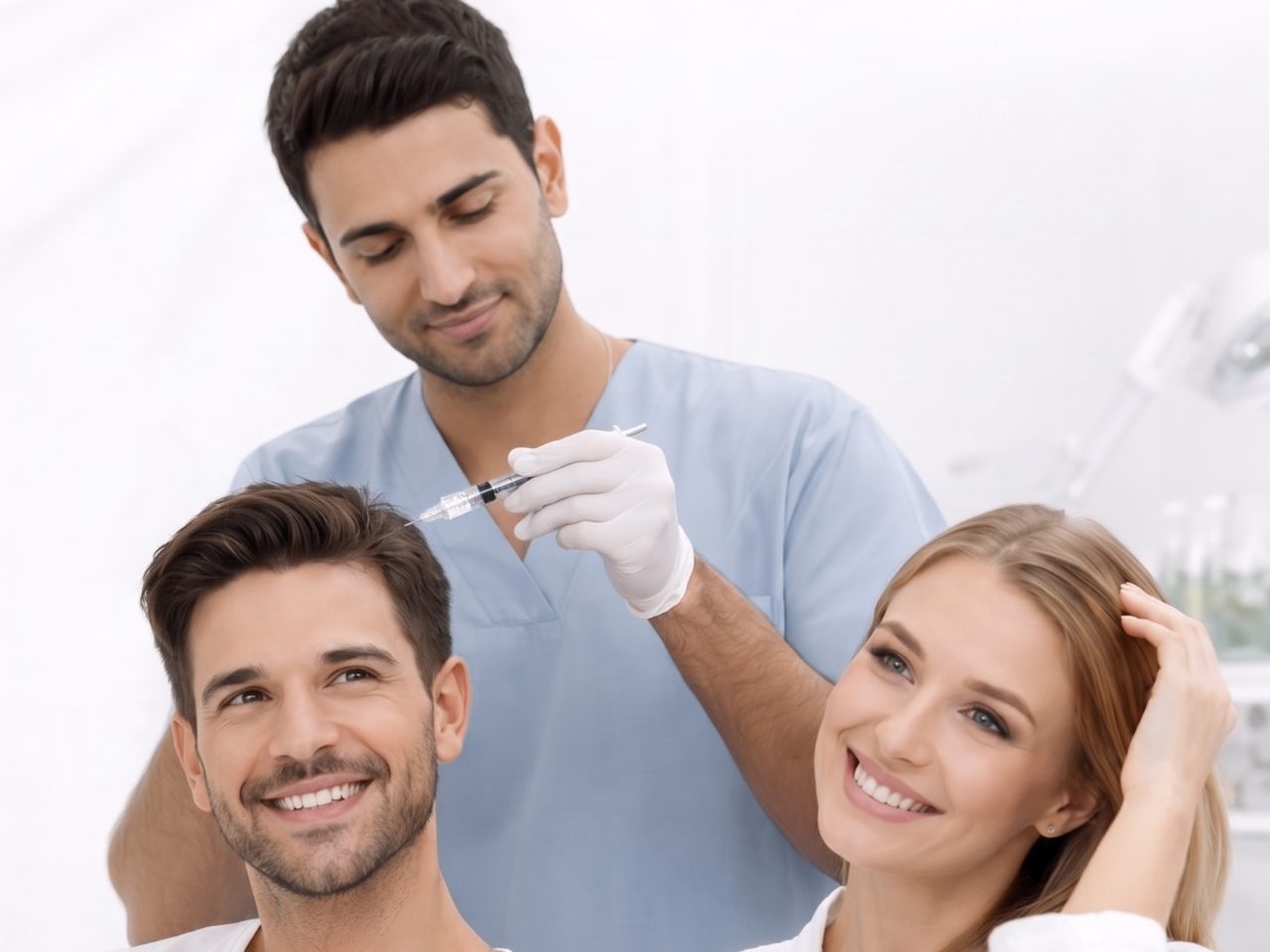
Growth factor hair treatment is a non-surgical scalp protocol in which medical-grade growth factor formulations — proteins such as VEGF, IGF-1 and FGF that normally regulate the hair cycle — are delivered into the scalp through microchannels or fine mesotherapy injections. The aim is to shift follicles out of the resting (telogen) phase back into the active growing (anagen) phase and improve the micro-circulation that follicles depend on.
Growth factors are frequently layered with PRP hair restoration in Dubai, hair exosome therapy and biotin hair mesotherapy inside one structured plan, and reviewed alongside our wider hair loss treatments in Dubai.
Benefits
- Reduces daily shedding and hair fall
- Strengthens weak, brittle hair shafts
- Improves scalp micro-circulation and follicle nutrition
- Extends the active growth (anagen) phase
- Supports and prolongs PRP or exosome results
- No downtime — suitable in a working week
Concerns we treat
Ideal candidates
Patients in Dubai with mild to moderate thinning who want a non-invasive, needle-light scalp programme — and patients who have completed a PRP or exosome course and need structured maintenance.
The treatment process
- 1Doctor-led scalp and hair-cycle assessment, with bloodwork where indicated
- 2Trichoscopy and baseline photography for objective tracking
- 3Scalp cleanse and topical numbing for comfort
- 4Microchannel or mesotherapy delivery of the growth factor formulation
- 5Aftercare guidance and a scheduled review at 3 months
None — mild scalp tenderness or pinpoint redness for a few hours is normal.
A doctor-led clinic in Dubai Healthcare City
At Silk Clinics in Dubai Healthcare City, every treatment is doctor-led, clinically supervised and tailored to your skin, anatomy and goals. We combine advanced technology, premium products and a refined patient experience — guided by our promise: Safety First. Beauty Always.
Meet our teamMedical conditions Growth Factor Hair Treatments can address
Our doctors recommend Growth Factor Hair Treatments for the following patient concerns. Click any condition to learn more about how we approach it at Silk Clinics in Dubai Healthcare City.
Growth factor hair treatment in Dubai — why patients choose it
Hair loss in Dubai is rarely caused by one thing. Hard water, chlorine, prolonged sun exposure, air-conditioned low humidity, iron or vitamin D deficiency and high-stress work cycles all shorten the hair growth phase. Growth factor treatment targets the biological signal itself: instead of only feeding the follicle, it re-instructs it to re-enter active growth.
Because the formulation is delivered through microchannels rather than deep injection, sessions are quick, comfortable and require no blood draw — which makes this a practical option for patients who cannot commit to the recovery window or needle load of other protocols.
In clinic we usually see growth factors used in one of two roles: as the primary protocol for early, diffuse thinning, or as structured maintenance after a course of PRP hair restoration or exosome therapy. Both routes are planned inside our wider hair support programmes in Dubai.
Every plan starts with diagnosis. If bloodwork shows low ferritin, vitamin D or a thyroid imbalance, that is corrected first — no scalp treatment outperforms an untreated systemic cause. Where nutritional support is part of the picture, our doctors may add vitamin therapy in Dubai.
How growth factors work on the hair cycle
Each follicle cycles through anagen (growth), catagen (transition) and telogen (rest). In pattern hair loss the anagen phase progressively shortens, so hairs are shed before they reach full length and thickness — the visible result is thinner, shorter, weaker hair rather than sudden baldness.
Growth factors such as VEGF improve the capillary network feeding the follicle, while IGF-1 and FGF signalling support keratinocyte proliferation and prolong anagen. Applied in a repeated monthly rhythm, the intent is cumulative: each session reinforces the signal before the effect of the previous one fades.
This is why the course structure matters more than any single session. A one-off treatment produces little measurable change; a completed 4–6 session course with maintenance is what shifts density on comparison photography.
Growth factors vs PRP vs exosomes — how our doctors choose
PRP uses your own platelet concentrate and requires a blood draw; it remains the most evidence-supported option for androgenetic thinning and is usually first-line where hair loss is established.
Exosome therapy uses regulated, medical-grade vesicles carrying regenerative signals with no blood draw, and is often selected for sensitive scalps, needle-averse patients or as an amplifier alongside PRP.
Growth factor treatment sits between the two: lighter than PRP, delivered through microchannels, and well suited to early thinning and maintenance. Many patients in Dubai run a sequenced plan — PRP or exosomes to drive change, growth factors and biotin mesotherapy to hold it.
Aftercare and what to expect between sessions
Leave the scalp product-free for 12 hours after treatment, then resume your normal routine. Avoid swimming pools, saunas and direct midday sun for 24 hours — chlorine and heat both irritate freshly channelled scalp skin.
Continue any prescribed topical or oral therapy without interruption; growth factors support medical therapy, they do not replace it. Use a gentle, sulphate-free shampoo and rinse with cooler water, which matters more than usual given Dubai's hard water.
Expect a temporary increase in shedding in the first 2–3 weeks in some patients. This is normal cycle synchronisation as resting hairs are pushed out ahead of new growth, and it settles by week 6.
Expected results
Reduced shedding within 4–8 weeks, visibly stronger shafts at 3 months, and improved density and coverage at 4–6 months when the full course is completed.
Recovery timeline
- Day of treatmentMild scalp tenderness and pinpoint redness; avoid hair products for 12 hours.
- Day 1–2Normal washing, styling and exercise resume; no visible marks.
- Week 4–8Shedding on the pillow and in the shower typically reduces.
- Month 3–4Hair shafts feel thicker and stronger; regrowth appears at the hairline and part.
- Month 6Density review with comparison photography and a maintenance plan.
Maintenance sessions every 2–3 months to hold density and follicle quality.
An initial program of multiple sessions is typically recommended, then transitioning to maintenance.
Suitable candidate
- Mild to moderate diffuse thinning
- Shedding after stress, illness, dieting or pregnancy
- Patients wanting a needle-light alternative to PRP
- Patients maintaining results after PRP or exosomes
Not suitable for
- Scarring alopecia or fully miniaturised, follicle-free areas
- Active scalp infection, open wounds or inflamed dermatitis
- Untreated thyroid, iron or hormonal deficiency — these are corrected first
- Pregnancy and breastfeeding, unless cleared by your treating doctor
Risks & side effects
Every medical procedure carries some risk. We discuss these fully at consultation so you can decide with confidence.
- Temporary scalp tenderness or tightness
- Pinpoint redness at delivery sites for a few hours
- Rare small bruising with injection delivery
- Rare transient headache after treatment
- Very rare local irritation or allergic reaction to a formulation component
Combination treatments
Growth Factor Hair Treatments works well alongside the following treatments. Your doctor will recommend the right combination at consultation.
What Silk Clinics doctors commonly recommend
For early diffuse thinning we typically recommend a 4–6 session monthly growth factor course combined with biotin hair mesotherapy, plus correction of any iron, vitamin D or thyroid abnormality found on bloodwork.
For established androgenetic thinning, our doctors usually lead with PRP hair restoration or exosome therapy and use growth factors as the maintenance layer from month 6 onwards.
Progress is reviewed with standardised photography at baseline, month 3 and month 6, so decisions to continue, escalate or change protocol are made on evidence rather than impression.