The Hollywood smile is changing
For more than a decade, the phrase "Hollywood smile" described one recognisable look: very white teeth, all the same shade, with near-identical shapes lined up in perfect symmetry. It became a shorthand for cosmetic dentistry itself — and, in Dubai, for full sets of veneers.
In 2025 and into 2026, dental trade press and cosmetic practices have been reporting a noticeable shift. Rather than asking for the brightest possible shade, many patients now ask for teeth that look healthy, balanced and polished while still looking like their own (The Dentist, 2026). This is a trend in aesthetic preference, not a medical rule — some patients still prefer a brighter, more uniform result, and that is a valid choice to discuss with a dentist.
What is the new Hollywood smile?
The "new" Hollywood smile keeps the goal of an attractive, confident smile but changes the definition of attractive. Typical features include:
- Natural proportions — tooth length and width that suit the face, rather than a standard template.
- Realistic tooth shapes — slight variation between central incisors, laterals and canines, as natural teeth have.
- Controlled brightness — a bright but believable shade instead of an opaque, very white one.
- Translucency — edges that let a little light through, as healthy enamel does.
- Surface texture — subtle surface detail so teeth do not look flat or plastic.
- Balanced symmetry — a harmonious smile without every tooth being a copy of the next.
- Face-led design — planning around the lips, smile line, facial midline and skin tone.
Why ultra-white, identical teeth are becoming less popular
Several practices describe the change as a reaction to one-size-fits-all results that became easy to spot, especially where very opaque shades and identical shapes were used on every patient (The Perfect Smile Studios, 2026). On camera, in daylight and up close, very uniform teeth can read as artificial even when the dental work itself is sound.
None of this means a brighter smile is wrong. Preferences vary with culture, age, profession and personal taste. The broader movement is towards choice and individualisation — the smile is designed for the person rather than the person being fitted to a trend.
Natural-looking porcelain and E-max veneers
Ceramic veneers remain one of the main ways to change the colour, shape and proportions of front teeth. How natural they look depends on several factors working together:
- Material — traditional feldspathic porcelain and E-max (lithium disilicate glass-ceramic) are both lab-made ceramics with different strength and optical properties. Neither is automatically right for every patient; the choice depends on the tooth, the bite and the desired look.
- Shade and layering — how the ceramic is coloured and layered affects depth and translucency.
- Tooth preparation — the amount and shape of enamel removed affects how thin and natural the veneer can be.
- Laboratory work — the ceramist's skill in shaping, texturing and glazing.
- Clinical planning — the dentist's assessment of gums, bite, existing restorations and facial features.
Both porcelain and E-max veneers usually require some permanent removal of enamel. That step is not reversible: once enamel has been reduced, the tooth will always need a veneer or another restoration (ADA MouthHealthy). You can read more about materials and suitability on our dental veneers in Dubai page.
Minimal-prep and conservative cosmetic dentistry
A consistent theme in 2026 is preserving healthy tooth structure wherever clinically appropriate (Dental Scotland, 2026). Minimal-prep or thin veneers can sometimes be placed with less enamel reduction than traditional veneers, but they are not suitable for everyone (ADA MouthHealthy). Teeth that are crowded, rotated, very dark or positioned forward may need more preparation — or a different approach altogether.
Whether a minimal-prep approach is possible is decided at an in-person examination, often with photographs, scans and a trial design. Any claim that veneers never require tooth preparation should be treated with caution.
Composite bonding and small smile enhancements
For smaller changes — a chipped edge, a small gap, a slightly short tooth or minor shape irregularities — composite bonding may be considered. Tooth-coloured resin is applied and shaped directly on the tooth, usually with little or no enamel removal, and it can often be adjusted or removed later.
Composite generally picks up stain more readily and needs more maintenance than ceramic, and it may need polishing or repair over time. Our guide to composite bonding vs veneers explains the trade-offs in more detail.
Straighten first, veneers second?
Some patients consider veneers mainly to hide crowded or uneven teeth. In certain cases, moving teeth into a better position first with clear aligners can reduce the amount of tooth preparation needed later, or remove the need for veneers on some teeth entirely. Orthodontic treatment takes longer and is not right for every case, but it is worth discussing when conservation matters to you. See Invisalign vs braces for how aligners compare with fixed braces.
Digital smile design and personalised planning
Digital smile design uses photographs, video and, where applicable, intraoral scans to plan tooth proportions against the patient's face. Many clinics then create a wax-up or a temporary mock-up so the patient can preview the proposed shape in the mouth before any irreversible step.
The value of digital planning is communication: the patient and dentist can agree on length, shape and shade together. Digital previews are a planning tool and may not exactly represent the final clinical outcome — natural variation in teeth, gums and ceramics means the finished smile is refined at the try-in stage.
Natural white vs ultra-white — choosing a veneer shade
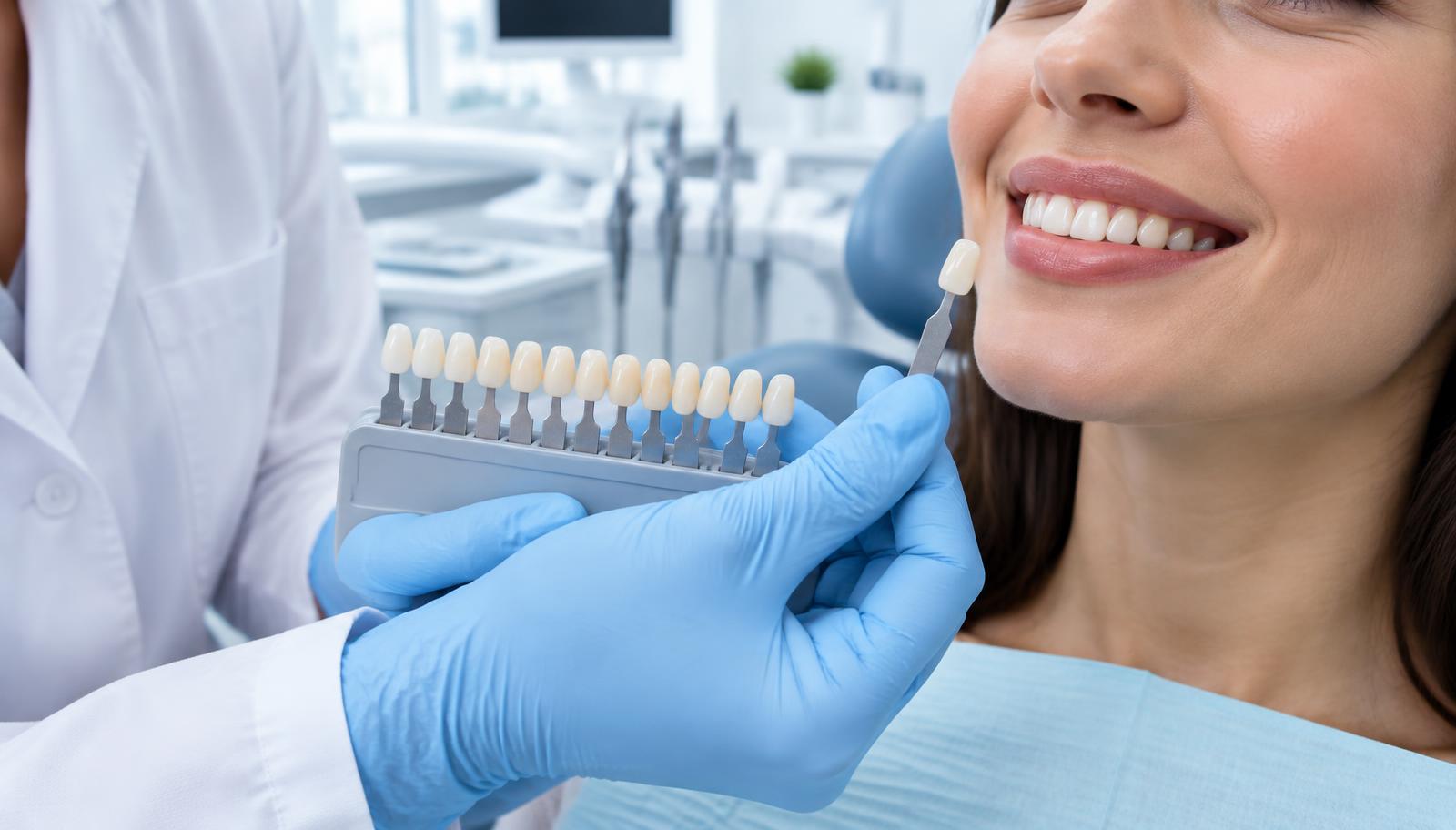
Shade selection should consider more than preference alone. Dentists typically look at the colour of any teeth that will not be treated, skin tone, the whites of the eyes, lip colour and how much of the teeth show when speaking and smiling. Some practices report patients moving from the very lightest bleach shades towards slightly warmer natural-white shades (Cinik Dental, 2026), but the right shade is individual.
If only a few teeth are being treated, teeth whitening before shade matching is sometimes recommended, because ceramic does not whiten once it is made.
What makes veneers look natural?
- Shape — suited to the face and to each tooth's position.
- Proportions — balanced width-to-length ratios across the smile.
- Translucency — subtle light transmission at the edges.
- Texture — surface detail that reflects light like enamel.
- Margins — well-finished edges that blend with the gum line.
- Shade — a believable colour that works with the untreated teeth.
- Smile line — edges that follow the curve of the lower lip.
- Individualisation — small differences between teeth rather than identical copies.
Hollywood smile vs natural smile makeover
| Traditional Hollywood aesthetic | 2026 natural aesthetic | |
|---|---|---|
| Shade | Very bright, often the lightest available | Bright but believable, matched to face and untreated teeth |
| Uniformity | Teeth closely matched in colour and shape | Balanced, with subtle tooth-to-tooth variation |
| Tooth shape | Often square and standardised | Shapes chosen for each tooth position and the face |
| Translucency | Often more opaque | Edges designed to transmit some light |
| Personalisation | Template-led | Face-led and patient-specific |
| Philosophy | Maximum visible change | Enhancement that still looks like the patient's own teeth |
Neither approach is universally better. Some patients prefer a brighter, more uniform result, and a good plan respects that while explaining what is clinically sensible.
Is the new Hollywood smile right for everyone?
No cosmetic dental treatment is right for everyone. Gum disease, active decay, heavy grinding, insufficient enamel or an unstable bite may need to be treated first — or may make veneers unsuitable. A dental assessment is needed before any recommendation.
Alternatives include professional whitening, orthodontic alignment, composite bonding, replacing old restorations, or simply choosing no treatment. Because ceramic veneers usually involve irreversible enamel removal, they should be a considered decision, not an impulse.
Natural-looking veneers in Dubai
At Silk Clinics in Dubai Healthcare City, cosmetic dental cases are planned by DHA-licensed dentists, with smile design reviewed against facial features, bite and gum health. Patients can browse veneer before-and-after cases and learn more about our Hollywood smile planning approach. Individual outcomes vary, and suitability is confirmed only after an examination.
Considering a smile makeover in Dubai? Book a dental consultation at Silk Clinics to discuss veneers, whitening, alignment and other options based on your teeth and aesthetic goals.
Sources and further reading
- The Dentist — Is the Hollywood smile era over? (Feb 2026)
- The Perfect Smile Studios — The rise of natural smile design (Feb 2026)
- Dental Scotland — Cosmetic dentistry trends 2026
- Cinik Dental — Hollywood smile trends 2026: natural vs ultra-white
- American Dental Association — MouthHealthy: Veneers
This article is general information reviewed by the Silk Clinics dental team. It describes aesthetic trends, not treatment recommendations, and is not a substitute for an individual dental assessment by a DHA-licensed dentist.
Personalized Skin Plan
Not sure if New Hollywood smile trend 2026 is right for you?
Answer 9 quick questions and get a doctor-designed pathway — with realistic timelines, downtime and session counts for your skin.
Browse the category
Explore all Dental Treatments in DubaiCosmetic and general dentistry in Dubai Healthcare City — veneers, Hollywood Smile, whitening, clear aligners and full-mouth dental care delivered by experienced specialists.
Treatments mentioned in this guide
Book a consultation
Considering New Hollywood smile trend 2026 in Dubai?
Our DHA-licensed doctors at Dubai Healthcare City will assess your concern and build a personalised, transparent plan — no obligation, no pressure.
Frequently asked questions
What is the new Hollywood smile?
Are natural-looking veneers trending in 2026?
Can veneers look like natural teeth?
View more frequently asked questions (5)
What is the difference between E-max and porcelain veneers?
Do teeth have to be shaved for veneers?
Can Invisalign be done before veneers?
How do dentists choose veneer shades?
How long do veneers last?
About the author

Dentist — Restorative & Family Dentistry
Dr Rigerta Bojaxhiu provides comprehensive dental care, including restorative dentistry and routine treatments for adults and families.
- BDS
- Diploma in Restorative Dentistry
Medically reviewed by Dr Ahmad Sadeqyar — Medical Director, Aesthetic & Regenerative Medicine.