Quick answer
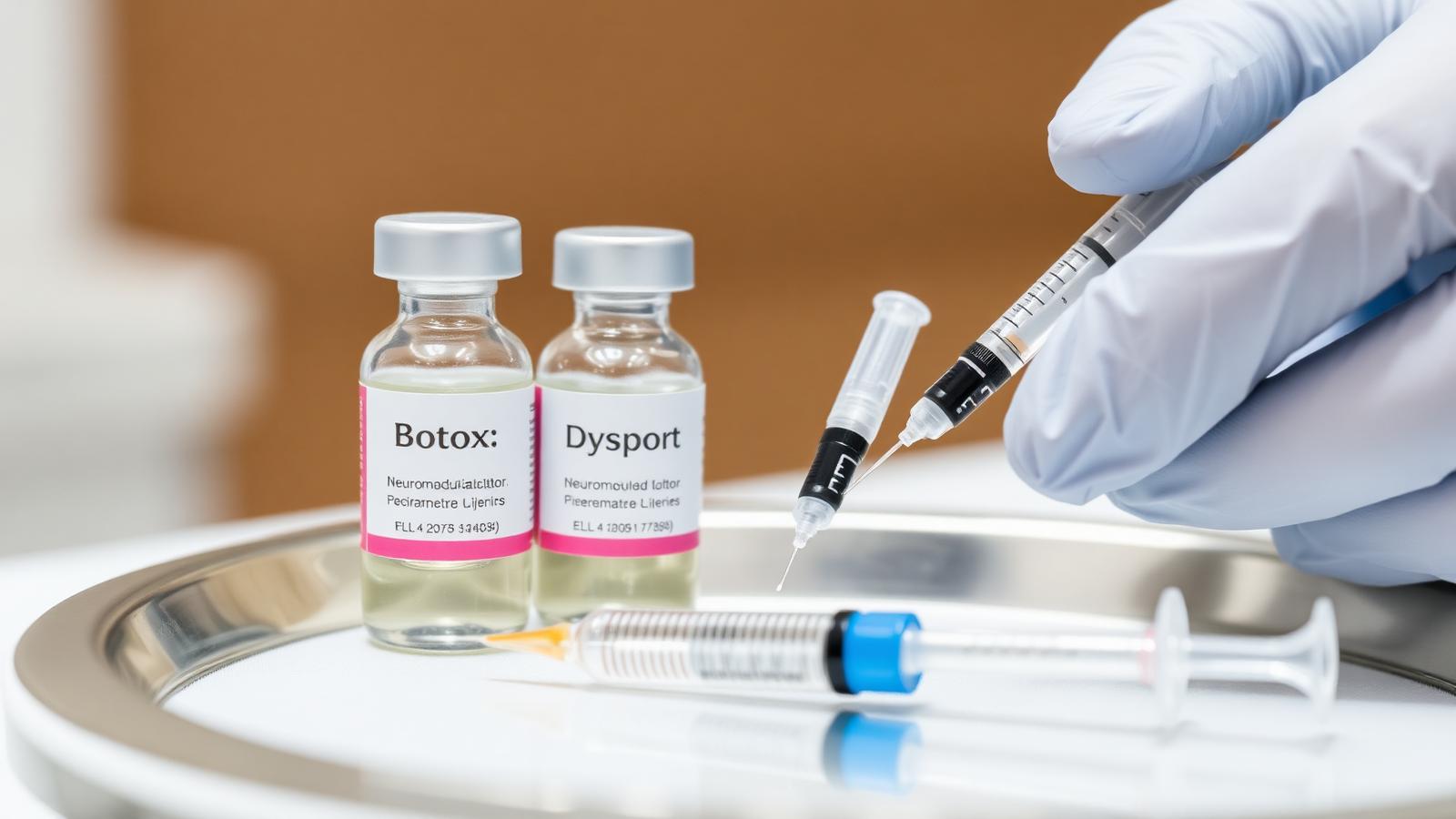
Botox and Dysport are both botulinum toxin type A neuromodulators with comparable results, safety and duration in skilled hands. Dysport acts slightly faster (2–3 vs 3–5 days) and diffuses a little more, which can be helpful in broad areas like the forehead. Botox has the longer track record and the unit-set most patients are familiar with. The right choice is matched to indication, anatomy and personal response — not to brand loyalty.
Last reviewed on byDr Suzanne Haddad&Noemi
Botox vs Dysport — side-by-side
| Feature | Botox | Dysport |
|---|---|---|
| Active ingredient | Botulinum toxin type A (onabotulinumtoxinA) | Botulinum toxin type A (abobotulinumtoxinA) |
| Onset | 3–5 days | 2–3 days |
| Full effect | 10–14 days | 7–10 days |
| Duration (typical) | 3–4 months | 3–4 months |
| Diffusion | More contained | Slightly broader |
| Unit conversion (Botox : Dysport) | 1 unit | ≈ 2.5–3 units |
| Best for | Precision work, glabella, around mouth, eyes | Broad forehead, larger treatment fields, fast onset preference |
| Brand familiarity | Most widely recognised globally | Established alternative, growing share |
| Cost framing | Higher per-unit, fewer units | Lower per-unit, more units — cost-per-effect is similar |
Botox and Dysport are the two most widely used neuromodulators worldwide. Both are formulations of botulinum toxin type A that temporarily reduce the activity of targeted muscles to soften dynamic lines and reshape selected facial features. They are not identical — they differ in unit conversion, onset, diffusion characteristics and, for some patients, perceived duration.
This is a doctor-led, balanced comparison written for patients in Dubai trying to decide between them. We cover what each is, how they compare on the variables that genuinely matter, whether one is 'better', how clinicians at Silk Clinics in Dubai Healthcare City choose, and who may not be suitable for either.
How they're similar
Both Botox and Dysport are botulinum toxin type A, both work by temporarily blocking nerve signals to targeted muscles, and both are evidence-based, regulator-approved injectables used millions of times globally each year. For the most common cosmetic indications — frown lines, forehead lines, crow's feet — both produce comparable clinical results in skilled hands.
How they differ
The differences are subtle but real. Dysport has smaller molecular complexes and tends to diffuse slightly further from the injection point, which can be advantageous for broad treatment areas like the forehead and disadvantageous in precision work near sensitive muscles. Onset of action is often a day or two faster with Dysport (2–3 days vs 3–5 days for Botox). Duration in most studies is broadly similar, though some patients report longer or shorter persistence with one over the other based on individual biology.
Unit conversion is also different — Dysport units are not equivalent to Botox units, with a common 1:2.5 or 1:3 ratio. This does not mean Dysport is 'weaker' or 'stronger' — it means the units are scaled differently, and a properly trained clinician converts the dose accurately.
How clinicians choose in Dubai
For patients new to neuromodulators, Botox is often the more familiar starting point and has the longer track record. For patients with broader forehead treatment needs, slightly faster onset preferences, or who have shown reduced response to Botox over time (rare but possible due to antibody formation), Dysport is often preferred. Many Silk Clinics patients use one for several years, then switch — not because one is better, but because the choice should match the indication and the patient's individual response, not loyalty to a brand.
Can these treatments be combined?
Generally we do not combine Botox and Dysport in the same treatment area on the same day — there is no clinical advantage and dose conversion becomes unnecessarily complex. They are commonly used in the same patient over time, however: a patient may use Botox for several years, then trial Dysport based on indication, response or preference. Either can be combined within the same visit with dermal fillers, skin boosters and energy devices.
Clinician perspective
What do Silk Clinics clinicians commonly recommend?
Silk Clinics clinicians choose based on indication and individual response, not on brand. For first-time patients with classic glabellar and crow's-feet treatment plans, Botox is often the default starting point because of its long track record and familiar unit-set. For patients with broad forehead treatment needs, faster-onset preferences, or apparent reduced response to Botox over time, Dysport is the considered alternative. Both are excellent in skilled hands — what matters most is the injector behind the syringe.
Who may not be suitable?
- Pregnancy or breastfeeding.
- Known hypersensitivity to botulinum toxin or product excipients.
- Active infection at the injection site.
- Neuromuscular conditions such as myasthenia gravis, Lambert-Eaton syndrome, or ALS — require specialist assessment.
- Concurrent use of certain medications (aminoglycoside antibiotics, anticholinesterases) — disclose all medications at consultation.
Suitability is always confirmed at consultation — this list is general guidance, not medical advice.
In-depth: how each treatment works
What 'diffusion' actually means in practice
Onset, peak and decline
Why apparent 'resistance' isn't always immunological
How to evaluate a clinic's neuromodulator standard
Key takeaways
- Both are botulinum toxin type A and produce comparable cosmetic results in skilled hands.
- Dysport acts slightly faster and diffuses a little more; Botox is more contained.
- Unit conversion is not 1:1 — typically around 1:2.5 to 1:3 Botox to Dysport.
- Cost-per-effect is similar; cost-per-unit headlines are misleading.
- Injector experience matters more than the brand choice.
- Many patients use both across their treatment history — choice should match indication, not loyalty.
Related conditions
Personalized Skin Plan
Not sure if Botox vs Dysport Dubai is right for you?
Answer 9 quick questions and get a doctor-designed pathway — with realistic timelines, downtime and session counts for your skin.
Browse the category
Explore all Injectable Treatments in DubaiDoctor-administered injectables in Dubai for natural-looking rejuvenation — from Botox and fillers to skin boosters and collagen stimulators, performed at Silk Clinics in Dubai Healthcare City.
Treatments mentioned in this guide
Book a consultation
Considering Botox vs Dysport in Dubai?
Our DHA-licensed doctors at Dubai Healthcare City will assess your concern and build a personalised, transparent plan — no obligation, no pressure.
Frequently asked questions
Is Dysport better than Botox?
Why are Dysport units different from Botox units?
How long do Botox and Dysport last?
View more frequently asked questions (6)
Which one is better for the forehead?
Can I switch from Botox to Dysport?
What about resistance to Botox? Will Dysport work for me?
Is one safer than the other?
Which is better for a 'natural' look?
Will my results look different with Dysport vs Botox?
About the author

Aesthetic Doctor — Injectables & Skin
Specialising in natural-result injectables and advanced skin treatments, Dr Suzanne Haddad is known for her refined eye for facial harmony.
- MD
- Advanced Certification in Facial Injectables
- Member, AMWC
Medically reviewed by Noemi — Head Nurse, Laser Treatments & Aesthetics.